
Smarter welfare monitoring
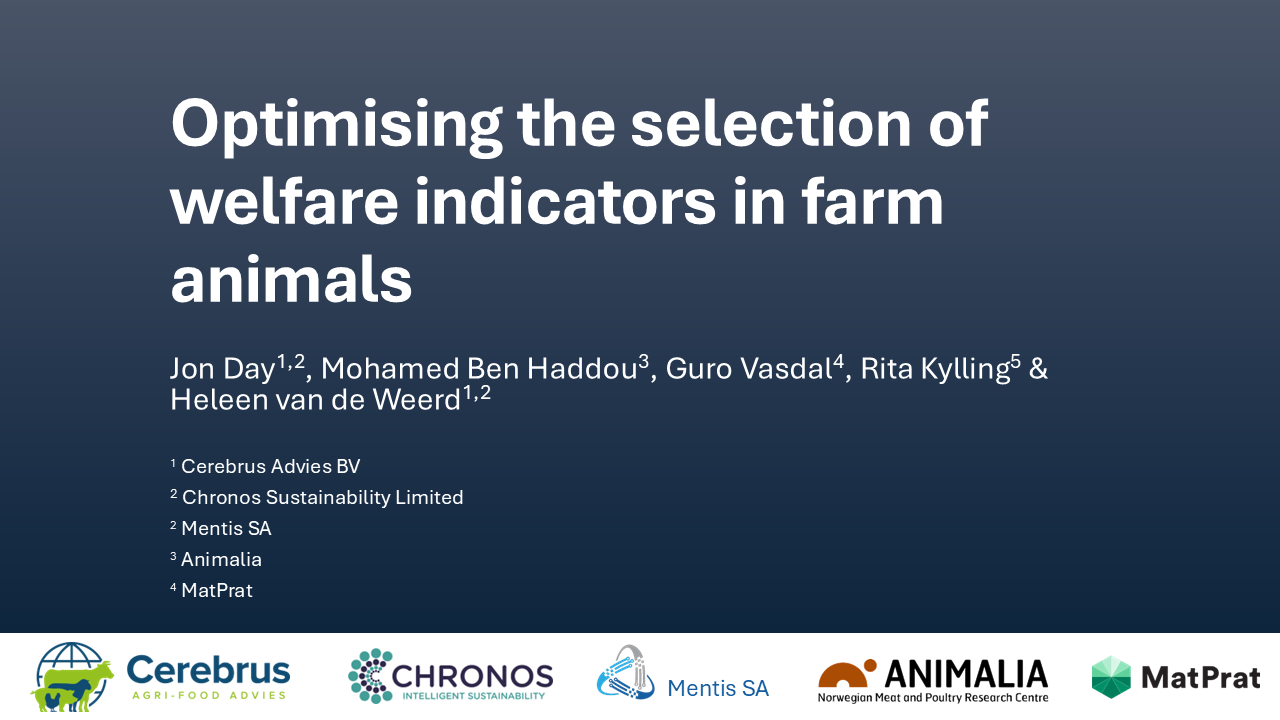
London, UK - On June 24 2026, Dr Jon Day delivered a presentation at the Science for Animal Welfare conference entitled "Optimising the selection of welfare indicators in farm animals".
New research demonstrates how a data-driven approach can help businesses, policymakers and researchers select effective combinations of animal welfare indicators, making welfare monitoring more practical and efficient.
Monitoring farm animal welfare is essential for identifying problems, measuring progress and driving improvements. However, with hundreds of potential welfare indicators available, selecting the most meaningful measures can be a complex and time-consuming task.
Research presented by Jon Day and colleagues explores how mathematical optimisation techniques can simplify this process, helping stakeholders identify small combinations of indicators that provide valuable insights into animal welfare.
The research builds on the concept of “iceberg indicators” – animal-based measures that can reflect multiple welfare consequences. Rather than assessing every possible measure individually, the approach identifies combinations of indicators that capture a broad range of welfare risks and consequences.
As part of the project, the research team developed a database of 389 welfare indicators covering dairy cattle and calves, pigs, beef cattle, broiler chickens, laying hens and sheep. Drawing on scientific evidence, including European Food Safety Authority (EFSA) assessments, the database links indicators to relevant welfare hazards and consequences.
The team then developed an enhanced optimisation algorithm that considers not only how many welfare issues an indicator covers, but also its ease of use, the severity of associated welfare consequences and how easily underlying hazards can be mitigated.
The results demonstrate the potential of this approach. In proof-of-concept analyses, just four indicators for broiler chickens and three for laying hens housed in aviaries were sufficient to provide the same coverage of linked welfare hazards and consequences as the original six-indicator sets.
The enhanced algorithm also proved highly efficient, identifying optimised combinations of up to 50 indicators in under 200 milliseconds on average during testing.
Importantly, the approach allows welfare monitoring to be tailored to different priorities. Food businesses can focus on practical indicators that support improvements across their supply chains, regulators can select measures suited to targeted inspections, and researchers can design more efficient welfare assessment protocols.
By moving beyond simply selecting indicators with the broadest coverage, this research offers a flexible, evidence-based approach to welfare assessment that balances scientific relevance with real-world practicality.
Ultimately, the work could help organisations make more informed decisions, reduce the burden of welfare monitoring and focus resources where they have the greatest potential to improve farm animal welfare.
View the presentation